
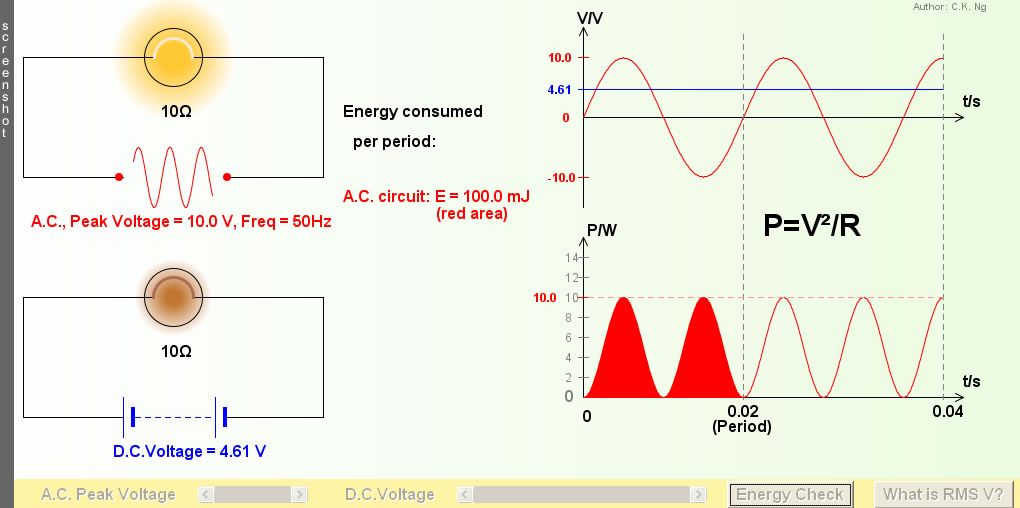
Root-mean-square voltage

(http://ngsir.netfirms.com)


Simply speaking, the root-mean-squae (RMS) value of an alternating voltage is the quivalent d.c. voltage that can deliver the same amount of eregy to a resistor as the a.c. does over a cycle.

More about RMS

This applet may help students understand what root-mean-square voltage is.

You are advised to play it by follwing the procedures:

1. Choose the kind of waveform of the a.c.

2. Shift the waveform up and down if necessary..

3. Guess the RMS V by shifting the d.c.V (blue horizontal line) up and down.

4. Press , then the area (energy) under the red a.c. curve and that under the blue horizontal line will be found and displayed separately. If the two areas are equal, the d.c. V is just the RMS V of the a.c. If they are not equal, an advice will appear on the top of the line. Repeat Steps 3-4 until you find the RMS V.

5. Instead, you may press at any time to have the blue horizontal line set correctly at the RMS valuie immediately.